
How to respond better without losing the human touch
Customer service has become one of the most delicate areas for any SME. Not because replying to messages is something new, but because customer expectations have changed completely. Today, a customer may contact a business through WhatsApp, the website, social media, or email, and expect a fast, clear, and consistent answer without having to repeat the same issue in every channel.
The problem appears when the volume of conversations grows and the business starts replying as best it can. One message is left pending, another is answered by a different person, a query is duplicated, and part of the context gets lost between applications. The internal feeling is often the same: customers are being served, but customer service is not fully under control.
Artificial intelligence can be extremely useful in this scenario, but only when it is used with judgement. Applied well, it reduces waiting times, organizes conversations, and frees the team from repetitive tasks. Applied poorly, it creates cold answers, avoidable mistakes, and an experience that customers perceive as improvised.
The key is not to replace human service, but to organize it better. AI should handle repetitive work so people can step in where they truly add value.
What customers expect when they contact a business
Most customers are not looking for a long or complex conversation. They want something much simpler: a business that responds well and responds on time. When that does not happen, brand perception can deteriorate quickly, even if the product or service itself is good.
In practice, customers especially value five things:
- receiving a first response without excessive waiting,
- understanding the information clearly,
- not having to repeat their case in every channel,
- finding a clear path to resolution,
- and being able to speak to a person when the situation requires it.
That last point is essential. Automating customer service does not mean hiding the human team or turning every conversation into a closed flow. It means filtering, organizing, and preparing each interaction better so the team can spend its time on the cases where its intervention makes a real difference.
The real problem is usually a lack of structure
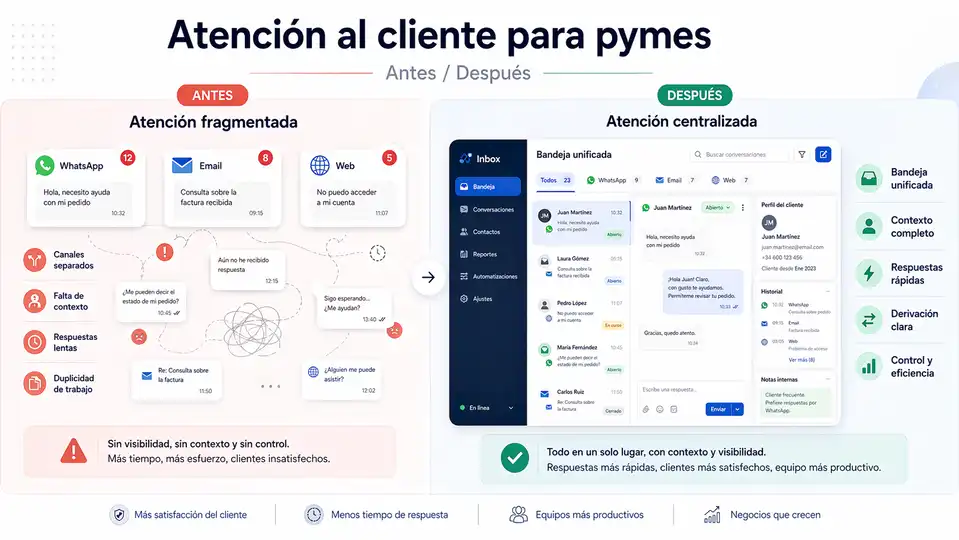
Many SMEs believe their main problem is lack of time. That is partly true, but there is almost always a deeper cause: customer service is fragmented.
One customer writes through WhatsApp, another uses the website form, and another replies to a previous email. One team member answers in the morning, someone else takes over in the afternoon, and if there is no complete view of the conversation, important details are lost. In the end, service quality depends too much on memory, availability, and goodwill.
In that context, even a simple query can become a small friction point. Not because it is difficult to solve, but because the process behind the answer is not properly organized.
That is why, before thinking about automation, it is worth thinking about centralization. An SME needs to know who has written, through which channel, what has already been answered, what is still pending, and when a person should step in. Without that foundation, any AI remains a superficial layer.
What SMEs should automate in customer service
The best automation is not the one that tries to solve everything. It is the one that clearly distinguishes which tasks can be managed quickly, consistently, and safely.
In customer service, AI works especially well in processes such as:
- answering frequently asked questions,
- sending welcome or first-response messages,
- classifying the reason for contact,
- collecting basic details before escalating the case,
- providing information outside business hours,
- following up on repetitive requests,
- and routing each conversation to the right team or person.
These tasks do not require constant creativity. They require order, context, and clear rules. That is precisely why they are a strong starting point for an SME that wants to improve customer service without complicating its daily operations.
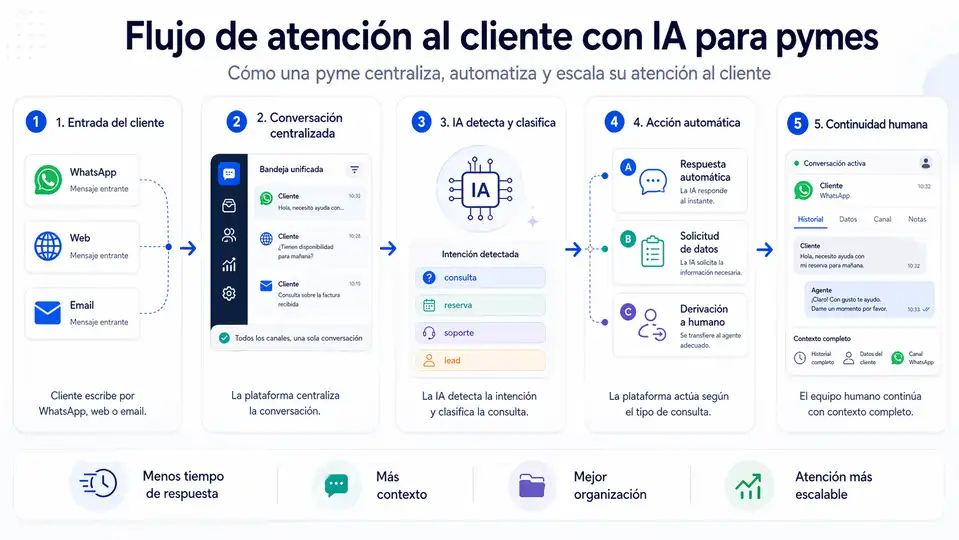
In a platform like Nexional, this automation does not work as an isolated bot. It is supported by a unified inbox, a knowledge base, and business rules so that each answer has context and continuity. The goal is not to reply for the sake of replying, but to help the business serve customers better with less operational burden.
What should not be left entirely to AI
Good automation also means knowing where automation should stop. Not every conversation should be resolved without human supervision, and forcing AI to close delicate cases can end up damaging customer trust.
A person should take over when:
- the customer shows frustration or anger,
- there is a sensitive issue,
- the case falls outside the usual process,
- the answer requires commercial judgement,
- the conversation involves a complaint,
- or the situation could directly affect the customer relationship.
Mature customer service is not the one that automates the most. It is the one that automates better. It detects what is repetitive, solves what is simple, and escalates what matters at the right time.
Good AI does not replace human judgement. It protects it, frees it, and activates it at the right moment.
The difference between adding a chatbot and designing a service operation
Many businesses test an AI tool and feel disappointed because they expect strategic results from a solution that is too superficial. They install a chatbot, load a few answers, and soon discover that the real problem is still there.
The reason is simple: the challenge is not only answering messages. It is how the entire service operation is organized around those messages.
A well-designed customer service operation needs four elements:
-
Context
Knowing who is writing, which channel they came from, what they asked before, and where the conversation currently stands. -
Judgement
Differentiating when a query can be solved automatically and when it should be passed to the human team. -
Continuity
Preventing the customer from noticing a break between automation and human intervention. -
Traceability
Recording what was said, what was requested, what was solved, and what remains pending.
This is where an operational solution like Nexional fits naturally. It does not simply generate answers; it helps centralize channels, preserve each customer’s history, and create an orderly transition between AI and the human team.
What changes when an SME organizes customer service properly
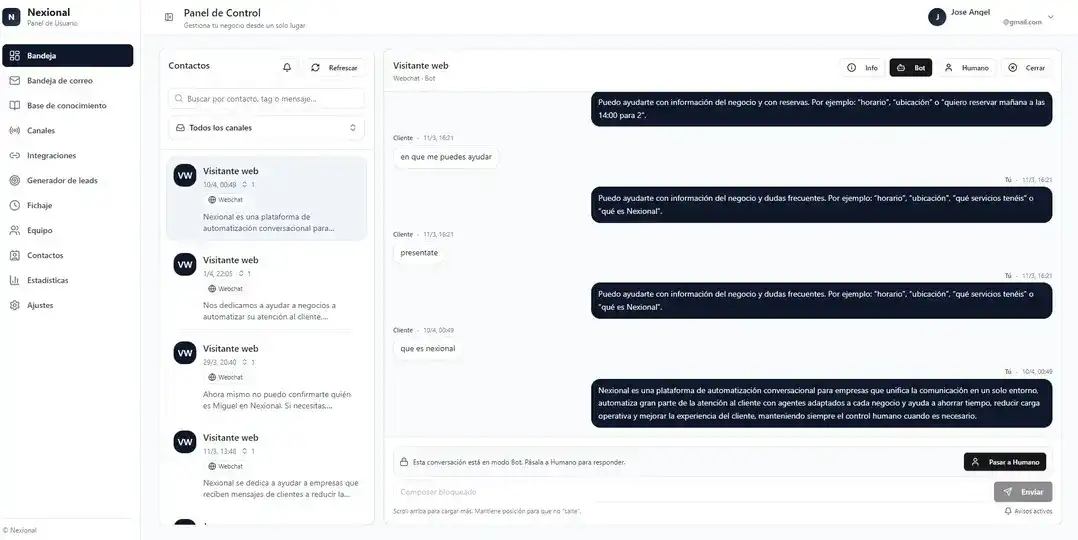
When a business starts managing its conversations better, the change becomes visible very quickly. Not only in response times, but also in the team’s overall sense of control.
The same answers are no longer repeated again and again. Errors caused by missing context decrease. Messages outside business hours no longer fall into a blind spot. Conversations are handled more consistently, and the customer perceives a company that is more professional, more agile, and more reliable.
That impact is not only operational. It is also commercial. An SME that responds well builds trust; and a business that builds trust converts better, retains better, and places less pressure on its team.
How to start without overcomplicating the process
Introducing AI into customer service does not need to begin with a huge system or complete automation from day one. In fact, it is usually better to start with the most repetitive areas and measure the impact before expanding the scope.
A good starting point would be to:
- identify the most repeated questions,
- review which information should always be available to the AI,
- define which cases must always be passed to a person,
- unify the main contact channels,
- and measure whether the experience truly improves for both customers and the team.
This approach avoids one of the most common mistakes: using AI to look modern instead of using it to solve a real operational problem.
With Nexional, this evolution can be approached progressively. First, channels and context are organized; then the most repetitive answers and processes are automated; and finally, rules, handoffs, reservations, notifications, or integrations are added according to each business’s needs.
Conclusion
Customer service does not improve simply because a business adds more technology. It improves when the business responds with more order, more judgement, and more continuity.
AI can be a powerful ally for any SME, as long as it is used to strengthen the customer experience rather than replace it with automatic replies that lack context. The real step forward is not adding a bot, but building a faster, more consistent, and better-controlled way of serving customers.
At that point, Nexional provides a practical layer to centralize conversations, automate repetitive tasks, and keep human control where it matters most. Because good customer service is not only about replying sooner; it is about replying better.